The Interface Has Leverage. So Does Product Pull.
It took me a while to get into Acquired, but Devang talks about it so much that I eventually caved in.
Two ideas from the Vanguard episode felt particularly relevant to me.
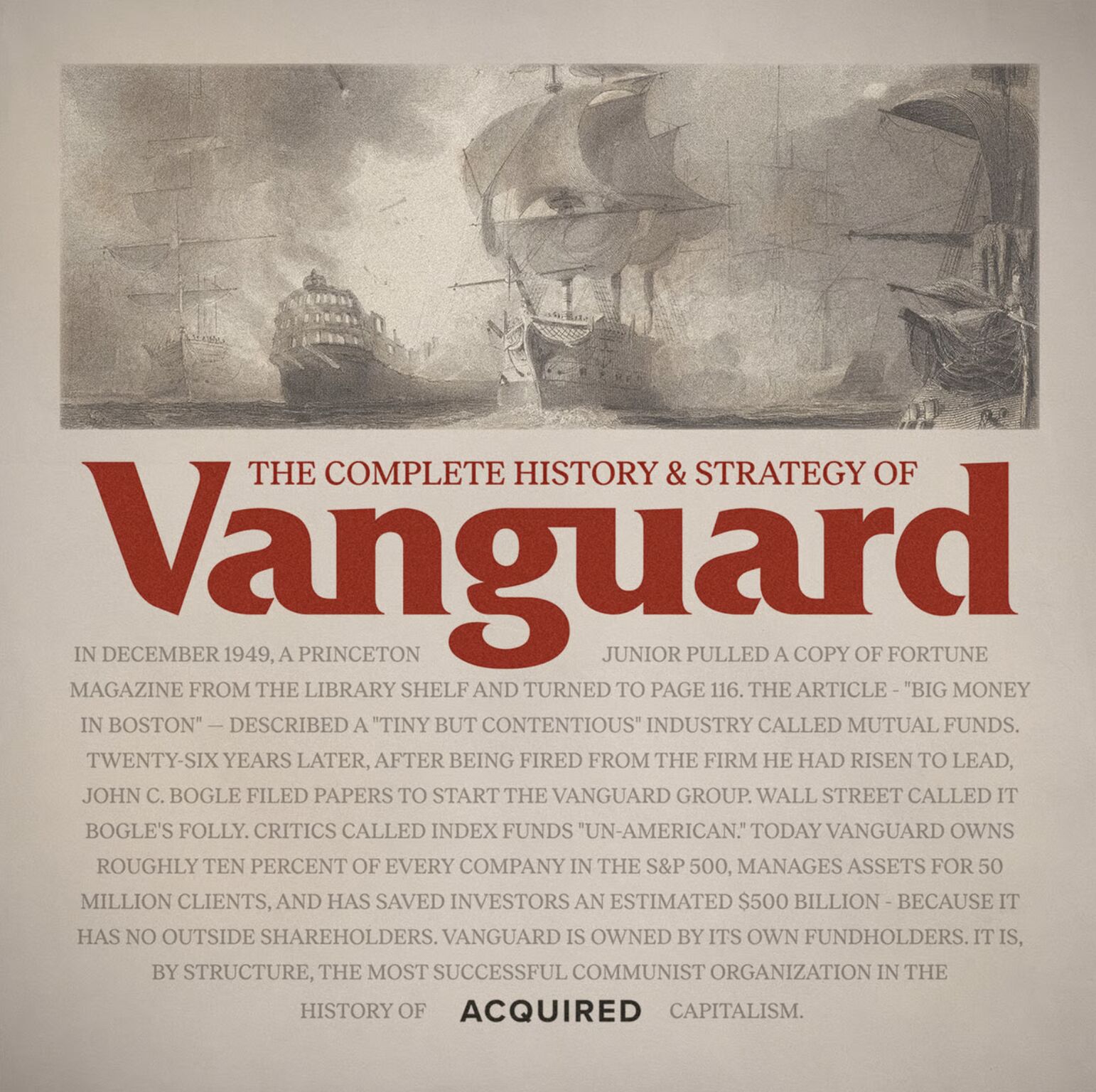
First, Bogle’s constraints built Vanguard: low fees and simple funds. Later, he fought new products, especially ETFs. His successors kept the mission, low-cost investing for customers, but stopped treating Bogle’s original product choices as sacred. And 99% of Vanguard’s assets under management came after he stepped down.
There is a useful distinction here between a mission and the implementation that first made it work. Constraints can create a company. They can also become dogma after the environment changes. Preserving the invariant does not require preserving every original product decision.
Second, you can buy Vanguard ETFs through Fidelity. Vanguard gets distribution; Fidelity owns the interface and the customer relationship.
This feels a lot like MCP-based products appearing inside Claude and ChatGPT. The interface has leverage: it controls discovery, interaction, and potentially the customer. But Fidelity still offers Vanguard because customers ask for it. A product that users explicitly insist on has leverage too.
The strategic question is therefore not simply whether the interface or the underlying product wins. It is whether your product is interchangeable infrastructure or something users will go looking for by name.
Vanguard suggests that distribution matters enormously, but genuine product pull still travels through someone else’s interface.