Your Company's Workflows Aren't Exhaust
An AI data company emailed us this morning about licensing Airspeed’s codebase to train next-generation AI models. The potential payout was more than $200,000, depending on volume and complexity.
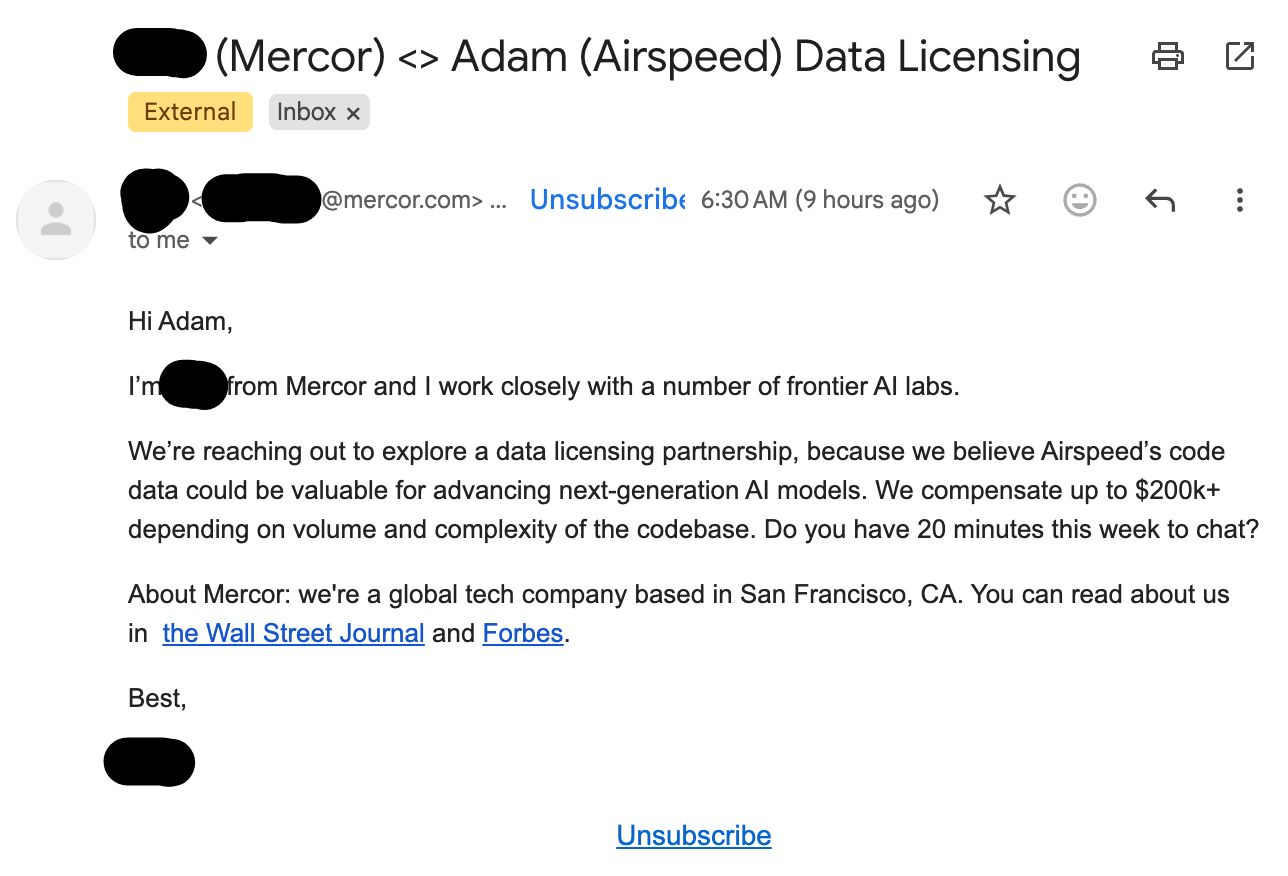
At first glance, this sounds like a market for private code. But I suspect the code is only part of what makes these datasets valuable.
Code tells you what a company intended its systems to do. The operating trace tells you what actually happened: how work moved through the system, where it stalled, which decisions people made, what they tried next, and whether it worked.
Public repositories are full of implementation. What they lack is complete, outcome-labeled trajectories from real companies. A CRM stage change, the conversation that caused it, the action someone took, and the eventual outcome are much more useful together than any one artifact in isolation.
This is now becoming an explicit market. Mercor licenses enterprise workflow data for frontier labs. Turing offers companies up to $1 million for their operating history. SpaceX’s $60 billion all-stock acquisition of Cursor is obviously about much more than data, but it points at the same underlying scarcity: systems used by real experts accumulate a proprietary record of how the work actually gets done.
The asymmetry is interesting. A lab can pay you once for a snapshot of that record. A system you own can keep learning from it and turn it into better execution every quarter.
We’re not selling.
That’s the bet behind Airspeed. The playbook is only the starting code. The moat is the running process: every deal, intervention, decision, and outcome feeding back into what the company does next. A competitor can copy your playbook. It can’t copy the history that shaped it.
Your workflows aren’t exhaust. They’re proprietary infrastructure. Capture them, govern them, and compound them.